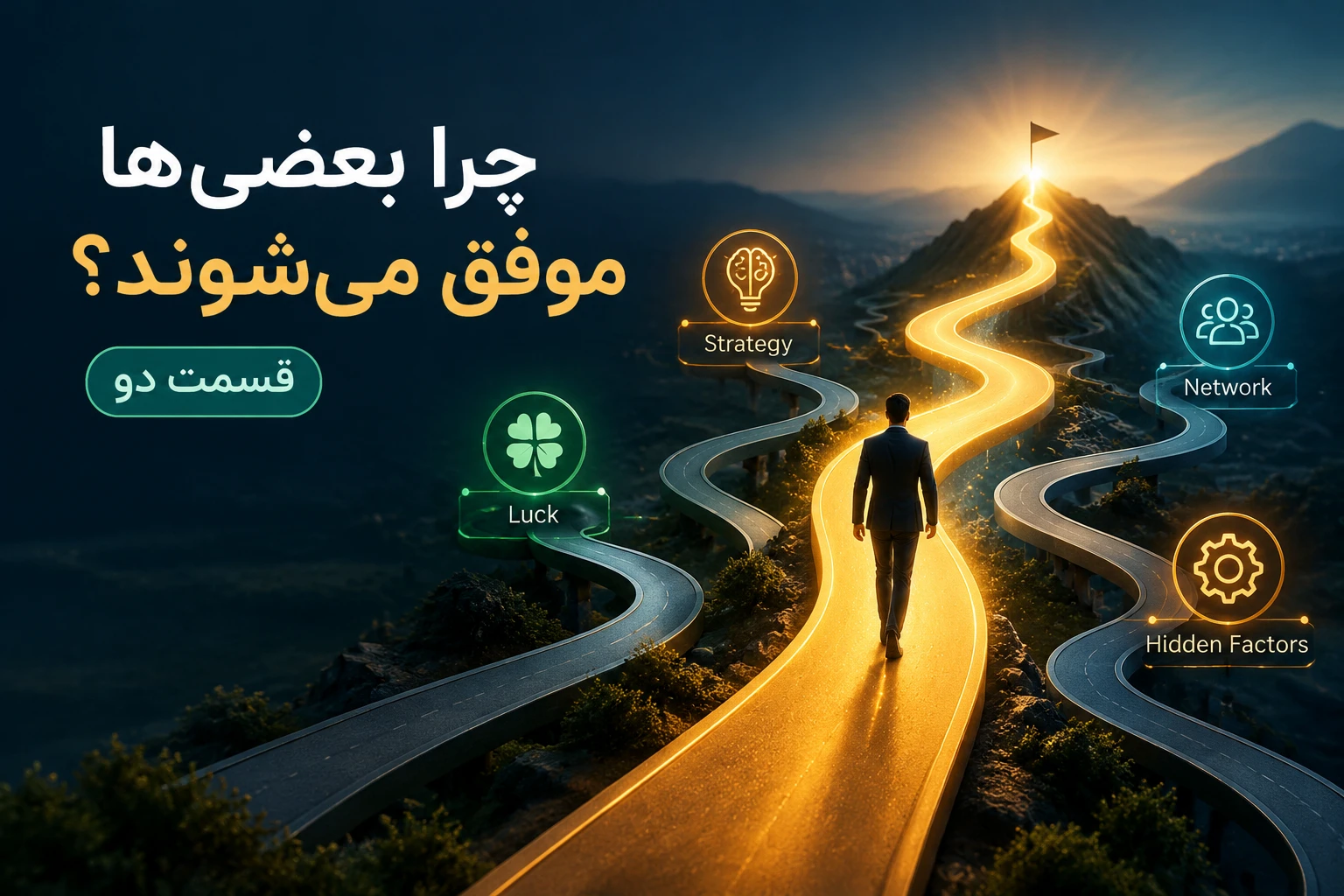
Why Do Some People Succeed? (Part 2)
In the previous part, we concluded that even when people make similar efforts and decisions, they can achieve different outcomes because luck and external circumstances also play a role. In this part, we’ll answer the following question: **How can we improve our chances of success in a world where outcomes are never fully predictable?**
How Can We Increase Our Chances of Success?
In Part 1, we discussed why two people who make similar efforts and decisions may still achieve different results. Some of this difference comes from factors beyond our control: economic conditions, when we get started, the people we meet along the way, and events we cannot predict in advance.
But if outcomes do not depend solely on our efforts and decisions, what can we do?
Should we accept that success depends largely on luck and simply wait for the right opportunity?
No. The point is not to control everything; it is to learn how to improve our chances of achieving the results we want, even when we cannot control everything.
Focus on Improving the Odds, Not on Guaranteeing the Outcome
Imagine two people who decide to start an online business.
The first spends several months developing a product that seems like a great idea to them. They complete it, launch a website, and then wait for customers to show up.
The second does not yet have a finished product. They start by building a simple version, show it to a group of potential customers, and find out whether anyone is willing to use it or pay for it. If the feedback is encouraging, they continue. If not, they change direction.
There is no guarantee that the second person will succeed. Market conditions may change, or a powerful competitor may enter the market. Even so, before investing a large share of their time and money, they have gathered information that can help them make a better decision about what to do next.
The main difference between these two people is not necessarily their intelligence, talent, or level of effort. It is the way they have chosen to deal with uncertainty.
The first tries to make the right decision from the outset.
The second makes a decision that can be adjusted.
This difference matters in many areas of life.
The Longer We Wait for Feedback, the More Likely We Are to Waste Our Effort
A common mistake is to assume that before starting something, we need to know everything, examine every angle, and come up with an almost flawless plan.
In practice, much of the information that matters only becomes available once we get started.
An idea may look great on paper, but no one may be willing to pay for it. We may learn a skill that we believe is in high demand, only to discover later that we need to take a different path to earn a living from it. We might even build a product people like—but not enough for it to become a sustainable business.
In situations like these, simply trying harder will not necessarily solve the problem. Sometimes, we need to figure out sooner which part of our approach is not working.
That is why, instead of asking only, “How much time have I put into this?”, it is worth asking another question as well: “What have I learned from this effort that can help me make a better decision next time?”
If we have been working for several months but still have no new information about customer needs, product quality, or the potential to generate revenue, our approach may need to be reconsidered.
The value of an experience is not determined only by its final outcome; it also depends on the information it gives us.
More Opportunities Do Not Necessarily Mean More Work
Imagine someone who has only one path to reach a goal. If that path does not work out, their entire plan is in trouble.
Now consider someone who has created several paths they can test to reach the same goal. If one path fails, that does not mean they have to give up.
Of course, this does not mean we should start dozens of projects at once or spread our energy across too many activities. Spreading ourselves too thin can reduce our chances of success.
The key is to create more opportunities while keeping the cost and risk manageable.
For example, someone who wants to earn an income through programming could identify a specific problem that a group of users would be willing to pay to solve, before building a large product. They could then offer a simple version of the solution and see how people respond.
With this approach, they do not have to wait until the very end to find out whether their idea has worked. Along the way, they have multiple opportunities to learn, make adjustments, and change course.
The more assumptions we can test at a lower cost, the more likely we are to eventually find a path that works.
Sometimes, We Need to Change Direction, Not Try Harder
Putting in a lot of effort is not always a sign that we are on the right path.
Someone may spend years pursuing a goal, even though the circumstances they are facing make it extremely difficult to achieve. In that situation, continuing simply because they have already invested so much time may be a mistake.
We tend to place a lot of importance on the time, money, and energy we have already spent. As a result, it can be difficult to walk away from a path that is not working. We may feel that if we stop, all our past effort will have gone to waste.
But we cannot recover what we have already spent. Today’s decisions should be based on current conditions and the information we have now—not solely on how much effort we have put in before.
Sometimes the best decision is to keep going; sometimes it is to adjust our approach; and sometimes it is to leave one path behind and start down another.
It is not always easy to tell which situation we are in. Still, setting clear criteria for evaluating our progress can help. If we decide in advance what signs would justify continuing, we are less likely to get caught up in emotional decisions.